|
|

楼主 |
发表于 2010-5-22 05:25:21
|
显示全部楼层
Saying The Unsayable, Part 4: Sexuality
By Mel Campbell on July 6th, 2009 at 12:38 pm
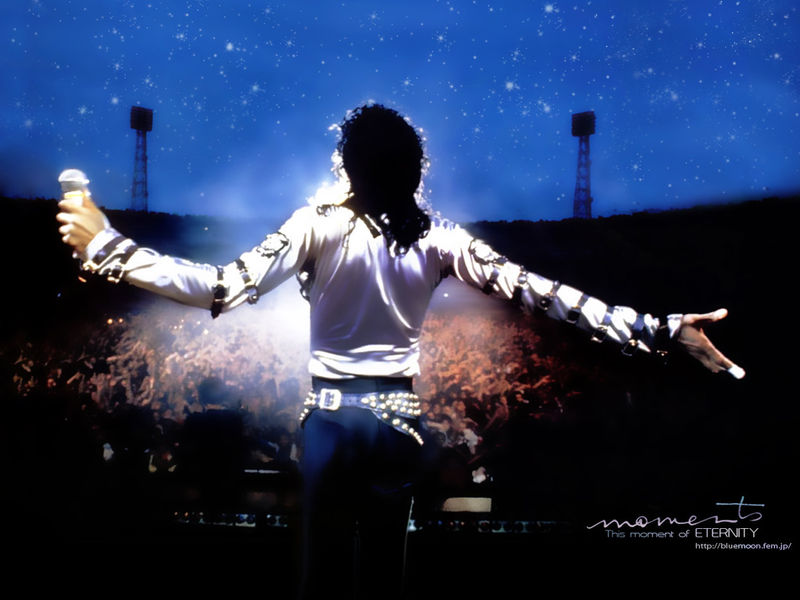
Michael Jackson on stage at his 30th anniversary celebration on 10 September, 2001 at Madison Square Garden, New York. Image: Dave Hogan
Michael Jackson on stage at his 30th anniversary celebration on 10 September, 2001 at Madison Square Garden, New York. Image: Dave Hogan
It has been well documented that white fears of moral degradation and miscegenation have historically surrounded forms of popular music associated with African-Americans, including jazz, rock’n’roll, disco and hip-hop. The same fears accompanied ‘cross-over’ artists like Eminem and Elvis Presley.
Interestingly, Elvis’s black-shoe-white-sock look and dance move of standing on the toes became Michael Jackson’s signatures. And even Jackson himself apparently sensed the darker parallels between Elvis and himself.
However, the sexuality conveyed in Jackson’s songs and persona was never racialised. Rather, as Richard Lacayo wrote in 1989 in People Weekly, he is:
“the prince of paradox. Has there ever been another sex symbol who displayed so little offstage libido? The gentle boy with the whispering voice who shed tears while recording the ET storybook album never accorded with the impregnable warrior on ‘Bad’ who snarls, ‘Your butt is mine.’ Michael spoke from the groin or he spoke from the clouds, but rarely from any point in between.”
This oddly bipolar sexuality neutralises any racialised sexual threat to mainstream white audiences. For Time magazine’s Jay Cocks, writing in 1984, Jackson was: “Undeniably sexy. Absolutely safe. Eroticism at arm’s length.” More recently, however, the gap between his songs and the perceived bizarreness of his persona widened to the point where Jackson was no longer ethereally sexy, but incomprehensibly perverted. Alexis Petridis from The Guardian newspaper writes bluntly that:
“the very fact [that banal romantic lyrics] are being sung by Jackson gives them a whiff of weirdness. ‘Let’s walk down to the park, making love until it gets dark,’ he trills. The thought of Jackson having sex is odd and frankly distressing.”
Jackson’s compositions have always been fraught with sexual anxieties that threaten to disrupt his credibility as a ‘heteromantic’ subject. Jackson usually casts himself as a desirable (but racially unmarked) man, whose naïvete and generosity are sexually and financially exploited by predatory women, themes that are particularly prominent in ‘Billie Jean’, ‘Wanna Be Startin’ Somethin’’ and ‘Dirty Diana’. Other songs, notably ‘In The Closet’, ‘The Way You Make Me Feel’ and ‘Remember The Time’, express desire for permanence and control over women and relationships.
The obvious use for non-verbal vocalisations in this sort of song would be as sexual noises; and the master of this type of vocalisation is self-proclaimed sex machine, James Brown. Brown’s non-verbal vocalisations stem from the call-and-response interplay between himself and members of his band, especially saxophonist Maceo Parker, all over an insistent groove set up by the JBs’ rhythm section. The vocalisations are narcissistic as well as orgasmic: he likes to shout “Watch me!” and “I got it!” between expostulations and grunts.
Brown’s speciality, however, is a brand of screaming that he imbues with visceral intensity. In a landmark New Yorker profile, Philip Gourevitch describes Brown in action:
“The scream has a sound of such overwhelming feeling that you cannot believe the man controls it. The impression, to the contrary, is that he is controlled by it, as if out of all the throats in the cosmos it had found his, and rendered him wild … Take this spectacle as you will – as death or birth; conquest or surrender; hellfire or apotheosis; sexual climax or heartbreak’s abjection; vaudeville hamming or sublime authenticity – you won’t be wrong. James Brown is a master of the simultaneous suggestion of opposing possibilities.”
By contrast, Jackson’s few attempts to use vocalisations as sexual noises are dismal. In the bridge of ‘In The Closet‘, they amount to whimpers and yelps, like an ignored puppy. While Brown performs his vocalisations over a simple, looped rhythmic pattern, Jackson requires swelling strings in the background to lend his vocalisations a sense of climax. It’s telling that although ‘In The Closet’ was an international top-ten chart hit in 1992, it didn’t make Jackson’s HIStory greatest-hits compilation.
On other occasions, Jackson uses the non-verbal vocalisations as a stand-in when words fail him. But where singers of tonal semantics like James Brown, Wilson Pickett or Jackie Wilson employ gospel-style wails, Jackson turns his voice into a robotic instrument, yelling on-beat like a metronome. In ‘Remember the Time‘, an impassioned bridge sequence dissolves into scatting: “Do you remember girl? / Do you? Do you? / Drrrr-up, dup-dup-dup! Drrrr-up duppa-dup!” He sounds like a machine; but importantly, he’s not a sex machine.
And finally: “Don’t it make you wanna scream?”
As I’ve argued from the beginning, reading non-verbal vocalisations is a tricky process. As they’re willed sounds, it’s not only impossible to tell whether the ‘meaning’ we understand is what the singer or speaker intends; it’s also just about guaranteed that we’ll get that meaning ‘wrong’. But sounds in-between also enable otherwise ‘unsayable’ things to be said.
So far, I haven’t mentioned one subgenre of Jackson songs: his pleas for peace. The earliest of these, ‘Man In The Mirror’ and ‘We Are The World’, were co-written or written by others, and have a proactive, optimistic tone. As Jackson’s career progressed, these songs became more embittered and defensive, linking the world’s ills to what Jackson perceived as his own victimisation by the media.
As I’ve outlined, music critics tend to assess the value of songs either by comparing their aesthetic or formal aspects to other, similar songs, or by treating the lyrics as narrative texts. In Jackson’s case, critics tend to use a third approach: using his lyrics as keys to ‘unlock’ his public persona. Accordingly, Jackson’s final studio album, Invincible, got a bollocking. In the NME, Mark Beaumont rails against self-pitying lyrics like “unblock my privacy” and “stop maliciously attacking my integrity”:
“Alright then, Whacksie, here’s the deal. You stop floating twenty foot statues of yourself down rivers, having your tackle discussed in court, organising ludicrous tribute concerts to yourself, having race-changes and spending billions of dollars violently ramming your image as a superhuman pop masterbeing down our throats, right, and we’ll stop taking any notice of you.”
A much more effective treatment of the same theme is 1994’s ‘Scream’, a duet with his sister Janet in which Jackson redeploys the non-verbal vocalisations. He not only discusses them in the lyrics, but also explicitly assigns them a use: as expressions of frustration and mutiny against a system he feels has entrapped him.
The screams in question are used in the same way Jackson deployed non-verbal vocalisations throughout his career. Their tones don’t signify a particular emotion; instead, they’re a stylised, distanced representation of emotion. Janet’s vocals, usually quite mellifluous, sound hard and crystalline here, like her brother’s.
Importantly, this emotional distance forms an operational strategy for Jackson. By screaming, he retreats from being a victim to his favoured position of observer and narrator. If we’re ever to make sense of this contradictory and troubled artist – and, by extension, of the complicated meanings surrounding music in general – we, too, must take a step back. Forgetting what we’re told, we’ll find out more about song by listening to what it cannot say.
This is an edited version of an academic paper that was first presented at the 2003 Australasian conference of the International Association for the Study of Popular Music, and later published in the musicology journal Context. |
|
 ●God is Love


 狗仔卡
狗仔卡 发表于 2010-5-22 05:21:03
 变色卡
变色卡 显身卡
显身卡 啊,对不起,不知LZ帖完了没有? 我站错台阶了吗?

 发表于 2010-5-22 07:33:00

